To import with Walmart Cross Border: Imports, you must follow Walmart’s policies regarding accurate reporting and documentation of items that may be considered dangerous goods. This guide provides information about item eligibility and what you can expect when booking a Walmart Imports shipment of dangerous goods.
What are dangerous goods?
In international shipping, the UNECE assigns every hazardous material a UN Number (also known as a UN code) to identify the dangerous good based on its hazard characteristics. WFS and Walmart Imports both require additional screening at the time you set up the item for any product that is or contains a chemical, aerosol, pesticide, battery (lithium or lead acid), or any over-the-counter item that may or may not be intended for human consumption.
Dangerous goods are separated into 3 categories, from most to least regulated:
- Dangerous goods
(These items are called hazardous materials or hazmat when the goods are being transported within the US. Dangerous goods and hazmat are different names for the same substances.)
These are substances or materials that are determined to be capable of posing an unreasonable risk to health, safety, and property when transported in commerce. They are identified by the required shipping paper, declaration, markings, labels or other hazard communication. Excepted dangerous goods
These are dangerous goods that are allowed to ship without some labeling, specific packaging and/or shipping paperwork due to a certain exception or exceptions. Examples include (but are not limited to):- Non-spillable batteries
- Refrigerators
- Wine refrigerators
- Air conditioners
- Ionizing smoke detectors
- Some lithium batteries (packed with or contained in equipment). More information on US lithium battery regulations here.
- General goods (also known as non-dangerous or non-hazardous)
Goods that are non-dangerous (non-hazardous or non-regulated) are not regulated as dangerous for transportation. They don’t require any hazardous material labels or markings. Examples include (but are not limited to) apparel, books or cooking pots.
Eligibility:
What can you import?
- Both general goods and excepted dangerous goods can be shipped from all ports by standard ocean service (full container load (FCL) and less than container load (LCL)). Both can be shipped by Priority speed when priority is available.
- Certain dangerous goods (UN3481 and UN3556) can be shipped from Ningbo, Shanghai and Yantian ports in China via standard FCL only. Dangerous goods cannot be shipped from other ports or by LCL at this time.
Packaging, labeling and paperwork must be compliant for both land and sea transport, including dangerous goods regulations required by the country of origin.
- Origin: Make sure your origin ground transportation provider is aware of any dangerous goods in your shipment so they can help you with any required paperwork or labeling. Walmart Imports does not offer any origin ground transportation service for shipments with dangerous goods.
- US: If the goods are being transported by domestic vessel or ground in the US for any leg of transport, please refer to Title 49 of the Code of Federal Regulations for what regulations and exceptions apply. Learn more in the labeling dangerous goods section of this guide.
Who can import dangerous goods?
You must be approved to import dangerous goods with Walmart Imports. Contact your account manager or Seller Support to request to ship dangerous goods.
Booking shipments in Seller Center
How to book
If you try to add an item considered a dangerous good to a Walmart Imports shipment, you’ll be notified if that item is eligible to ship and whether supporting documentation is required. You must provide this documentation for review when asked by the origin agent after booking. They’ll communicate with you via email about your shipment.
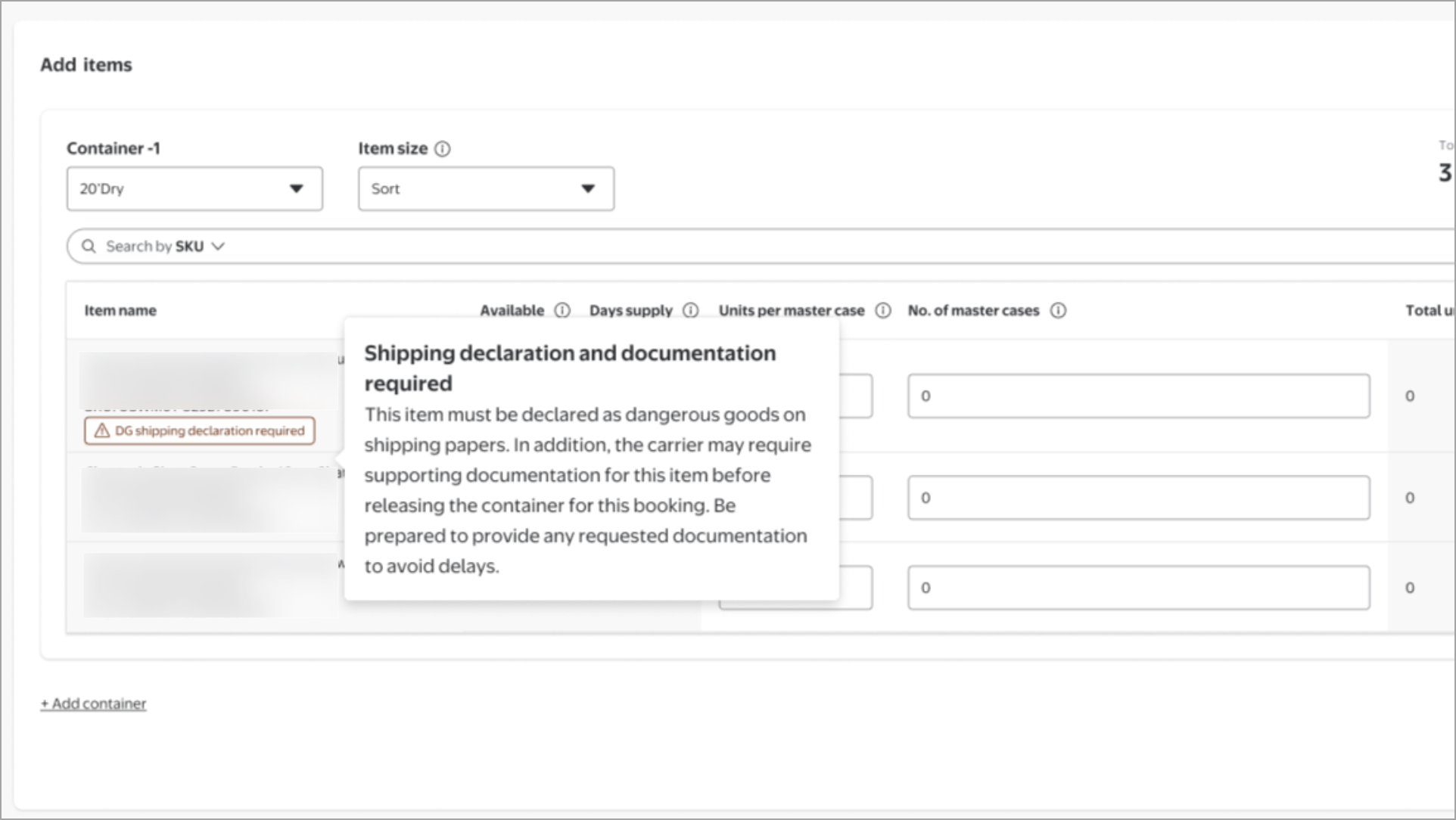
You’ll be prevented from adding items to your shipment that cannot be transported by Walmart Imports.
When possible, book containers with any dangerous goods separately. This helps prevent delays to other containers, since dangerous goods items and quantities can’t be changed after booking.
Pricing
All bookings including dangerous goods will include a “Hazardous cargo fee.” Learn more in the Imports shipping charges guide.
After booking
Editing shipments after booking
Dangerous goods cannot be added, edited or removed from a shipment after booking. If you need to change quantities, or add or remove an item altogether, contact Seller Support.
Declaring dangerous goods on shipping paperwork
Any dangerous goods in a container must be declared on your shipping paperwork. Work with your licensed customs broker to ensure you’ve properly declared your goods for customs entry.
You must also work with the origin agent to provide supporting documentation as requested by the carrier. Some examples are:
- Safety Data Sheet (SDS) (previously known as Material Safety Data Sheet (MSDS))
- Hazard Classification
- Identification Report for Transport of Goods
Labeling dangerous goods
You must properly label and mark all items containing dangerous goods for both international ocean and US transport before delivering your cargo to the port. Preparing your goods for safe and legal transportation is your responsibility and you must resolve any penalty assessed by any agency for missing, inadequate or inaccurate packaging, labeling or markings.
If your shipment arrives at a US WFS facility missing labels or markings required for US transportation, we may add them and charge the relevant unplanned prep services fee.
To ensure your items comply with the required labels and markings for dangerous goods transport, refer to the UN international regulations (see Chapter 5.2) for international ocean transport and to the US Department of Transportation (DOT) for US transport.
Labeling best practices
This section describes a few general best practices and is not comprehensive. Review the current regulations yourself to ensure your items are correctly labeled.
- Labels and markings may be printed directly on the box or added as a sticker.
- They must be unobscured (no other stickers, tape, etc. may cover any part).
- All labels and markings must fit on the same side of the outermost box. Do not fold stickers over corners. Do not overlap stickers. If they don’t fit on one side, use a larger outer box.
- They must be weather-resistant with smear-proof ink durable enough to survive at least 3 months of open sea exposure without fading or detaching (if using stickers, use marine-grade waterproof vinyl, not standard office paper labels).
- All labels and markings must be legible (easily read), and follow the applicable regulations for design, size, color and orientation on the box.
The label + marking for dangerous goods shipped internationally via ocean usually requires 3 parts:
Hazard diamond (label)
- Use the correct hazard diamond for the class of dangerous goods you’re shipping. For example, use the Class 9A Diamond for items containing batteries, not the standard Class 9 Diamond.
- Don’t put the UN Number inside the hazard diamond. The UN Number must be outside the diamond (it’s part of the “marking”).
- Minimum of 100mm x 100mm.
UN Number (marking, part 1)
- Must include “UN” (for example, UN 3481.) Do not mark the box with only the 4 digits.
- Required text size is determined by box size. Refer to the UN regulations for the minimum allowed size for your box.
Proper Shipping Name (marking, part 2)
- Use the exact Proper Shipping Name. For example, for UN3556, the shipping description is “Vehicle, lithium ion battery powered.” For UN3481, it is “Lithium ion batteries contained in equipment” or “Lithium ion batteries packed with equipment.” Don’t add any other text beyond the exact Proper Shipping Name.
- Same as above; required text size is determined by box size.
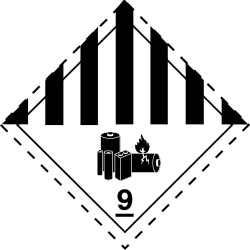 | 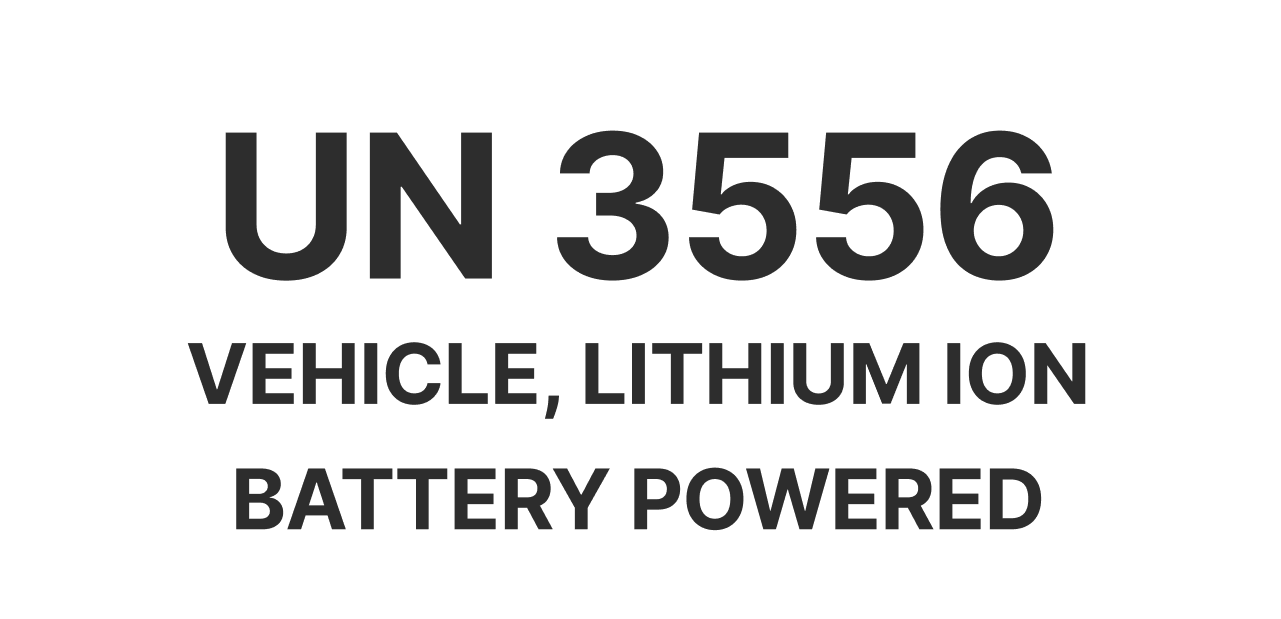 |
This is an example of a “label” (the Class 9A Diamond) and an example of a “marking” (UN Number + Proper Shipping Name). UNECE provides full resolution free downloads of all hazard diamonds via Wikimedia Commons, including the Class 9A hazard diamond pictured above. There is no specific marking to download; follow the UN regulations for design, size, color and placement when printing required markings. | |
- The US DOT regulations may differ from international ocean transport regulations. Add the required labels for all modes of transport at origin before sealing your container.
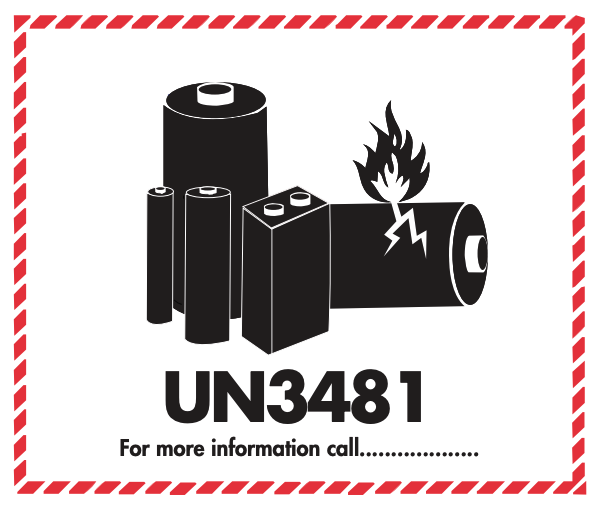 | 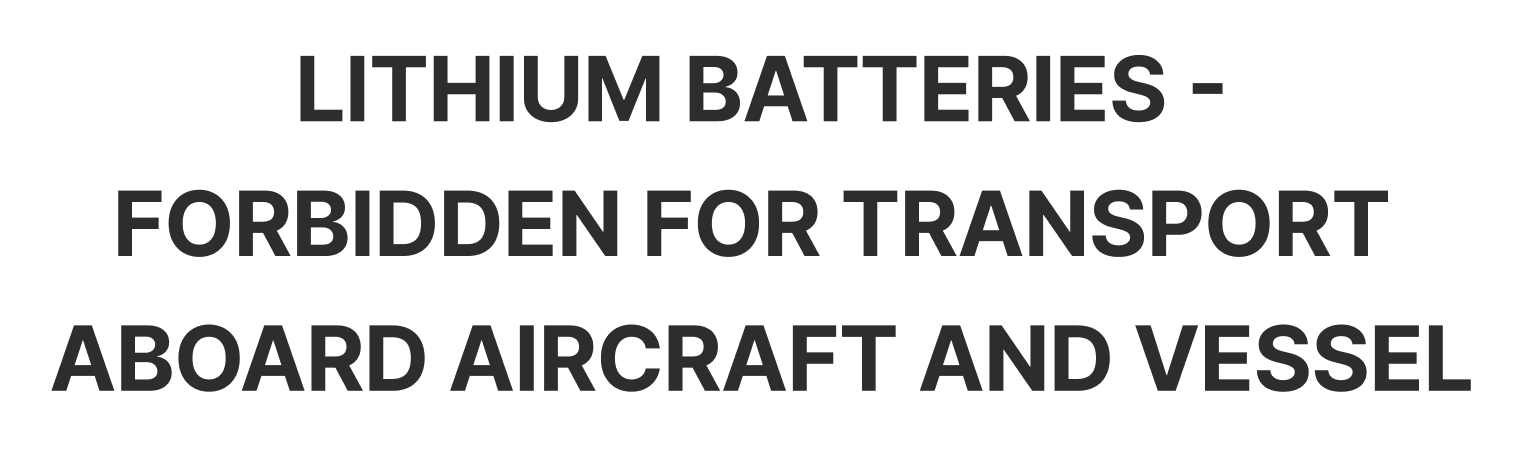 |
This is an example of a “lithium battery mark” and the “text marking” for transporting UN3481 within the US, which is “Lithium batteries – forbidden for transport aboard aircraft and vessel” in English. In this example, this item shipped from Asia to the US would have 5 labels/markings (3 international + 2 US). Note: The “text marking” warning may seem contradictory when the box is also traveling aboard a vessel, but conflicting or redundant stickers on boxes is a normal occurrence in multi-modal transport. | |
Labeling excepted dangerous goods
Excepted dangerous goods may require special labels or markings even if they aren’t required to be declared on shipping paperwork. Examples include (but are not limited to), certain items with lithium batteries like rechargeable flashlights, smartphones and electric toothbrushes. Refer to the US DOT Lithium Battery Guide for Shippers when packaging and labeling those items.
IMPORTANT: The information in this guide is provided for general informational purposes and as a resource to help you understand common dangerous goods shipping requirements. It is not legal or regulatory advice and may not address all requirements applicable to your products or shipments. You are responsible for determining and complying with all applicable laws, regulations, carrier requirements and other requirements for your products and shipments. Requirements may change, so you should consult current regulations and, as appropriate, your own legal, compliance or transportation advisors.
These pages offer more information: