Getting started
Account Set up
API
Catalog Management
Order Management
Payments
Walmart Policies
WFS
WFS Basics
Costs and Rates
Item Creation for WFS
Start in WFS
Deliver to WFS
Returns and Refunds
Advertisement
Growth
Content
Launches


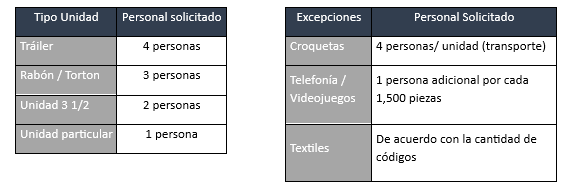
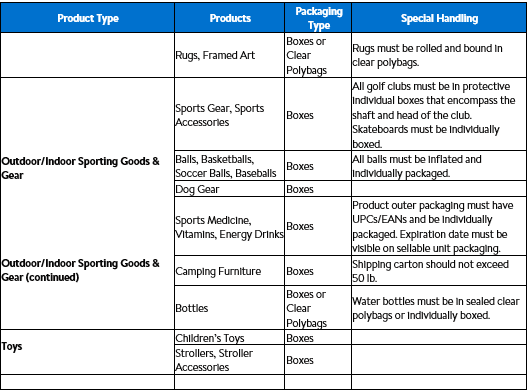
Your inventory must be shipped to a WFS-enabled distribution center within the United Mexican States.
Do not ship products requiring temperature control
Do not ship prohibited products
Products that do not meet WFS acceptance criteria
Do not ship products over 60kg
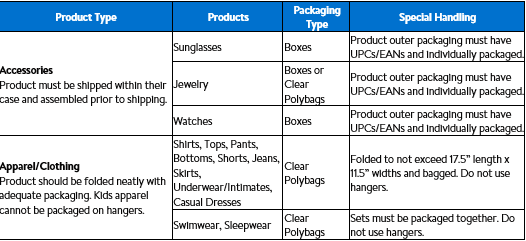
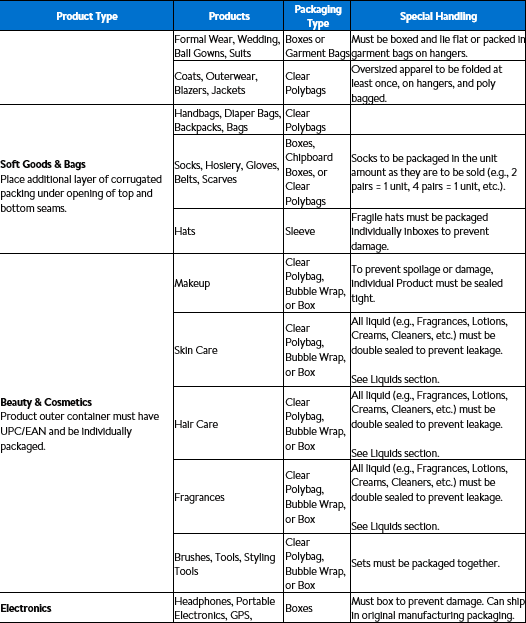
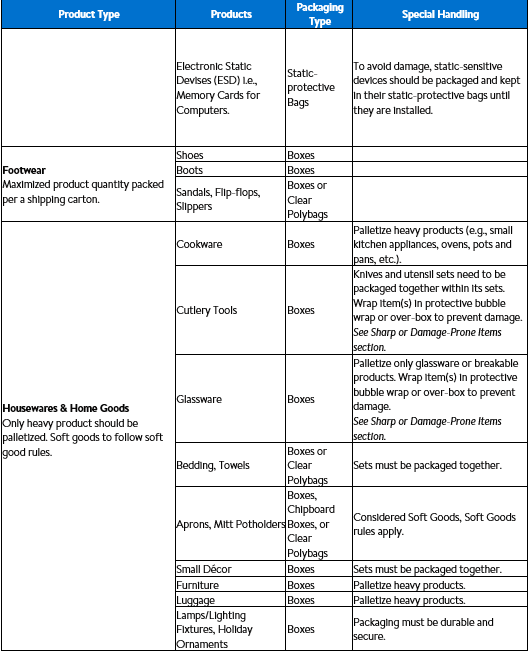
All products must be protected in a sealed or closed container, ready for sale.
Items must be packaged in clear or transparent polyethylene bags.
Price tags, product labels and/or any retailer’s specific labels should not be on the product packaging.
All required hazard warnings are clearly visible and evident on all clear polyethylene bags used.
All perishable products must include a visible expiration date on the saleable unit packaging.
Expiration dates should be shown in the format DD/MM/YYYY or MM/YYYY. If the expiration date is printed in a different format, a sticker with the correct format, covering the original expiration date, must be applied.
Products that expire and are kept in containers that require additional preparation, such as jars or glass bottles, must be prepared to ensure that the expiration date is accessible during receipt by CeDis.
For shoes, the country of origin label or marking must be on both shoes of the pair. Simply having the country of origin on the website or on a shoebox is insufficient. It must be physically on both shoes.
Packaging inserts and other forms of marketing materials are acceptable, while they should not be designed specifically for the other non-Walmart Fulfillment Services platforms. For products that are not properly prepared and packaged, shipping may result in you being liable for handling charges, which will be determined on an individual basis. All products must meet Walmart's packaging and labeling requirements
- Due to their very fragile nature, large electronic devices, such as computers, TVs and monitors, require special packaging to ensure safe transit through the ground network.
- We strongly recommend packing all large electronic devices by placing the manufacturer's box in another, slightly larger carton.
- Place a cardboard frame inside the outer carton to suspend the manufacturer’s box in the center of the outer carton (as shown in the picture below)
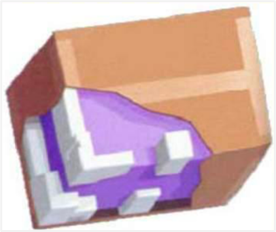
Inside the manufacturer’s carton, we suggest using custom molds to secure the product (as shown in the pictures below.) Instead of using Styrofoam for the custom molds, we recommend "foamed plastic".

The entire item should be wrapped in thick sheets of poly ethane or shell plastics.
Additional protection, such as foam sheeting, is required for monitors and TV screens.
Arrows indicating stacking and handling instructions will be printed on the box.
Box Certificate seal.
The product is in a 6-sided carton.
The carton should not yield when pressure is applied to either side.
Neither side of the product carton has an opening that makes some of the contents visible from the outside.
The product contents inside must be held securely in place inside the carton.
The carton must be sealed with tape, glue or staples.
The carton has clear markings indicating which side of the carton is the top.
The carton must not contain hazardous materials or goods as defined by Mexico’s Dangerous Goods Transportation Regulations.

Sharp items must be blister-packed in a manner that provides the safest packaging. The blister must cover the sharp edge and be securely fastened to the item so that the item will not slip inside the blister.
Place or wrap the unit in protective plastic shells or a protective box, so that the packaging fully covers the exposed edges. An overpackaged product is placed in an additional box during shipment. Ensure that the barcode is scannable without opening or unwrapping the unit.
Sharp products secured to a print and wrapped in plastic may also be allowed as long as the item is secured to the print (i.e. does not slip), the plastic is rigid enough to withstand handling and outside contact will not cause the sharp product to puncture the plastic.
Sharp products contained in plastic covered molded prints are generally not safe and are not recommended.
Cardboard or plastic sheaths alone on the sharp blade are not sufficient, unless the sheath is made of a rigid, durable plastic and is securely attached to the product to prevent slipping.
Sharp items should not be packed or shipped with non-sharp items.
Outer boxes with sharp items should be labeled as such.
Items must come in a solid six-sided box, with no exposure.
All items must be individually wrapped to prevent damage from contact with other items inside the container (e.g., a set of four wine glasses.) Packaged items must pass a drop test consisting of the following: Packaged items must be dropped five consecutive times from a height of 90 cm onto a concrete surface, once on the top, bottom, longest side, bottom corner, and longest bottom edge, without breakage or damage.
Items should not move or shake within the container and should pass a vigorous shaking test without breakage of the items.
Outer boxes containing glass, ceramic, breakable and/or fragile items should be labeled accordingly.
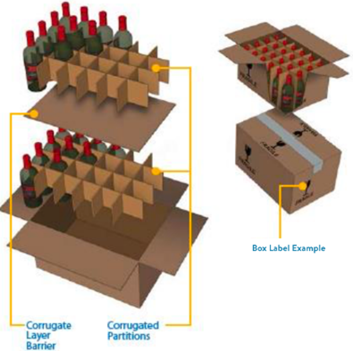
We strongly recommend corrugated dividers or partitions to prevent glass-on-glass contact and prevent breakage.
Protective coating on the glass container or bottle.
Rounded jars or bottles should be packed in a box or tray with an octagonal design, resulting in a tight package that minimizes movement.
The padding on the bottom of the box or tray should be sufficient to protect against wear or damage to the bottom tray during shipping.
Prohibited ProductsTemperature-controlled items
Food products
Medicines and supplements (vitamins, minerals, etc.)
Spray: If any item of merchandise contains a compressed gas or propellant (including bag-on-valve and other pressurized designs).
Ammunition (including buckshot, BB, air gun pellets, paintballs, slingshot ammunition) or Spray any product used to create ammunition
Liquid for zippo lighters
Charcoal
Car Batteries
Chemicals: Includes any item of merchandise containing a liquid, gel, paste, or powder that is not intended for human consumption. However, “Chemicals” also includes the following types of items intended for human consumption, inhalation or absorption: All over-the-counter drugs, including:
Tablets, pills, or capsules (e.g., pain relievers, vitamins, supplements);
Medical swabs, wipes, bandages, acne medications, and sunscreen;
Patches (heated and/or medicated, such as nicotine patches);
Liquids (e.g., cough medications, eye drops, ear drops, nasal spray, and inhalers);
Medicated shampoos, lotions, ointments and creams;
Lip balms, lip creams and petroleum jelly;
Contraceptive foam, films and spermicides; and
Product/Equipment sold with chemicals (e.g., vaporizers sold with medications), including electronic products.
Compressed gas cylinders: butane gas, fire extinguishers, propane gas
Bleach
Fertilizers
Pesticides (any product intended or labeled to kill, repel or mitigate any pest, viruses or bacteria)
Paint Thinners
Motor oil
Pool chemicals
Household cleaners
Syringes with needles (other types of needles, including empty syringes, sewing needles, cooking needles/syringes, lancets and automotive/tire needles are OK)
Dangerous goods regulated by the Transportation of Dangerous Goods Regulations and the Secretariat of Infrastructure, Communications and Transportation